Category: Personal Growth

  • Stop Letting Everyone Else Tell You How To Live

    Stop Letting Everyone Else Tell You How To Live

    You graduated. You got the job. You’re trying to be responsible. So why does it still feel like everyone else received a map that somehow skipped you?

    If you’ve ever asked yourself, “Why do I feel so lost in my 20s?” — you’re far from alone.

    You scroll through social media and watch people get engaged, buy homes, launch businesses, travel the world, celebrate promotions. Meanwhile, you’re wondering whether you’re making the right decisions or simply surviving one week at a time.

    No one really prepares you for this stage of life. People talk about graduation, your first job, becoming an adult, but very few talk about the confusion that comes after. The uncertainty. The pressure. The quiet fear that you might be falling behind.

    The truth is; feeling lost doesn’t mean you’re failing. Sometimes it means you’re growing.

    Let’s explore why this season feels so overwhelming — and how to move forward with actual clarity and not a borrowed lifestyle.

    1. Living Your Life Using Everyone Else’s Timeline

    Comparison has become one of the easiest habits to fall into. Every time you open your phone, you’re invited into carefully curated snapshots of other people’s lives — engagements, new apartments, dream holidays, career milestones. What you don’t see are the doubts, disappointments, and difficult conversations behind those highlights.

    Life isn’t a race. Someone else’s success doesn’t delay yours. Your journey has different lessons, different opportunities, different timing. Instead of asking “why am I behind?” — try asking “what is this season teaching me?” That question changes everything.

    2. Discern Everyone’s Opinion

    Honestly? A lot of us are winging it. There’s no universal life manual, no one-size-fits-all blueprint for a life well-lived — which is exactly why discernment matters so much. Discernment is the ability to recognise that something can look genuinely good, even brilliant, on someone else, and still not be for you.

    Scripture actually names this skill directly. 1 Thessalonians 5:21 instructs us to test everything and hold on to what is good. Not reject everything unfamiliar, and not accept everything either, but to test it. Discernment was never about closing yourself off from other people’s wisdom. It’s about refusing to swallow it whole without asking whether it was ever meant for your life in the first place.

    Ask yourself honestly: what would your life look like if no one was watching or forming opinions about it? What would you actually do? How would you actually show up?

    Take the current trend of extreme morning routines — 4am wake-ups because a favorite influencer swears by them. If you’re a night nurse, that routine isn’t wisdom, it’s just incompatible with your actual life. It’s easy to watch someone who seems to “have it all together” and assume their routine is the reason why, while quietly forgetting you’re not living the same life, with the same demands, the same body, nor the same purpose.

    We’ve somehow convinced ourselves we need the big thing, the massive accomplishment, the visible milestone. It’s completely fine to crave more and want abundance, but it’s worth asking honestly: do you crave it because it’s genuinely yours, or because everyone around you has it?

    I learned this the expensive way with something as simple as the gym. Years ago, I skipped the gym five minutes from my house to drive across town to the “trending” one — the one with the crowd, the aesthetic, the right people. I’d arrive already tired from the commute, wait for equipment because of the crowd, and after nearly three hours, walk away having actually used maybe two machines. Add the drive back, and it was a six-hour production — and if I’m honest, it was all to get a picture that looked like I was showing up too.

    It took longer than I’d like to admit to realize I didn’t actually want to be there. I was showing up because other people were showing up, and some part of me wanted to be counted among them. Gyming isn’t the problem — the problem is when the version of a routine, a habit, a lifestyle you’re borrowing isn’t actually built for who you are or who you’re becoming. Then it stops being growth and starts being a very well-disguised distraction. Not just gyming — the waxing appointment, the yoga class, the famous café, the destination everyone’s suddenly visiting. Borrowed rituals rarely fit the life they’re borrowed into.

    3. Nobody Told You Adulthood Comes With Constant Uncertainty

    As children, life follows a predictable pattern — school, exams, graduation. After that, everything becomes your responsibility. Which career? Which city? Which relationship stays, which one ends? What to eat? The endless daily decisions can feel exhausting, and it’s completely normal to feel overwhelmed making choices without a clear roadmap.

    Clarity doesn’t always arrive before action. Most people discover their purpose while moving, not while waiting for certainty to arrive first.

    4. You’re Becoming Someone New

    Your twenties are full of identity shifts. You outgrow friendships. Your priorities change. Your interests evolve. The version of you from five years ago may not fit the life you’re building now — and that discomfort doesn’t mean you’re making a mistake. It means you’re changing.

    5. You Don’t Fully Know Who You Are Yet and That’s Not Failure

    This might be one of the biggest reasons your twenties feel disorienting: you simply don’t know yourself completely yet. That’s not a character flaw. That’s just what this decade is for.

    There’s a well-known line, often traced back to John Lennon, that life is what happens while you’re busy making other plans. Your twenties are proof of that. You can plan the five-year trajectory in detail and still end up somewhere entirely different — not because you failed, but because becoming yourself was never going to follow a spreadsheet. Life happens in the in-between, in the parts you didn’t plan for, and that’s not a detour from the process. That is the process.

    6. You’re Carrying Expectations That Were Never Yours

    Think about the expectations you’ve quietly accepted — married by a certain age, home owned, salary hit, children had, everything figured out. Who actually created those deadlines? Family? Culture? Social media? Many of us spend years chasing goals we never intentionally chose. Ask yourself: what kind of life do I actually want — not the life that earns applause, but the one that feels true?

    7. You’re Trying To Control Every Outcome

    When life feels uncertain, we crave certainty — five-year plans, career plans, relationship plans. Planning is wise. Believing you can control everything isn’t. Some of life’s best turns arrive through detours you didn’t choose: the job you didn’t get, the city you never planned to move to, the friendship that changed everything. Sometimes a closed door is protection from a path that was never meant for you.
    You can understand detours better from my previous post.

    8. You’re Ignoring Your Inner Life

    Many people pour everything into external achievement — career, money, relationships, status — while neglecting what quietly sustains them: emotional health, mindset, values, faith, peace. Success without inner stability tends to leave people feeling hollow no matter how much they’ve accomplished. Invest in who you’re becoming, not just what you’re accomplishing.

    9. You’re Expecting Yourself to Have Everything Figured Out

    Most adults don’t actually have it figured out. They just get more comfortable learning as they go. Life isn’t an exam with one correct answer — it’s continual growth. Give yourself permission to learn, to change your mind, to begin again. Growth doesn’t come from having every answer. It comes from being willing to keep moving.

    What Can You Do If You Feel Lost?

    • Stop comparing your timeline. Every life unfolds on its own schedule.
    • Limit whatever fuels comparison. Protect your peace over your feed.
    • Write down what actually matters to you — not what impresses others.
    • Take one small step daily. You don’t need the whole plan.
    • Practice discernment daily. Test what you’re taking in — from advice, trends, and expectations — before letting it shape your life.

    A Different Perspective

    What if this isn’t the season you’re falling behind in? What if it’s the season you’re becoming someone capable of carrying everything you’re praying for? Seeds spend a long time growing beneath the surface before anyone notices them. Growth often looks invisible before it becomes obvious. Don’t underestimate the quiet seasons, they’re usually preparing you for the visible ones.

    Frequently Asked Questions

    Is it normal to feel lost in your 20s?
    Yes. Many people experience uncertainty during this decade because they’re navigating major transitions, shifting identities, and increasing responsibility all at once.

    Why do I feel behind in life?
    Comparison, inherited expectations, and social pressure create the illusion that everyone else is progressing faster than you.

    Will this feeling go away?
    It usually eases as you gain clarity through experience and intentional decisions. The goal isn’t eliminating uncertainty completely — it’s learning to move forward despite it.

    Final Thoughts

    If no one’s told you this recently, let this be your reminder: you are not behind. You are not broken. You are not failing because you don’t have every answer. You’re living through one of the most transformative decades of your life.

    Some days will feel uncertain. Some decisions will stretch you. Some dreams will take longer than expected. None of that means you’ve missed your purpose and none of it means God has either. He’s not confused about your timeline, even on the days you are.

    Keep showing up. Keep testing what’s actually yours to carry. Keep growing. Because sometimes the greatest transformation doesn’t happen when everything around you changes. It happens when you do.


    Are you currently in your twenties? Or have you ever experienced feeling lost? What helped you find your footing — or what are you still figuring out? Comment below and let’s talk about it — your story might be exactly what someone else needed to read today. And if you’re new here, subscribe below to get reflections like this sent straight to your inbox.

    Welcome to The Faith Mindset — a safe space to learn, grow, and thrive.
    I’m so glad you’re here.
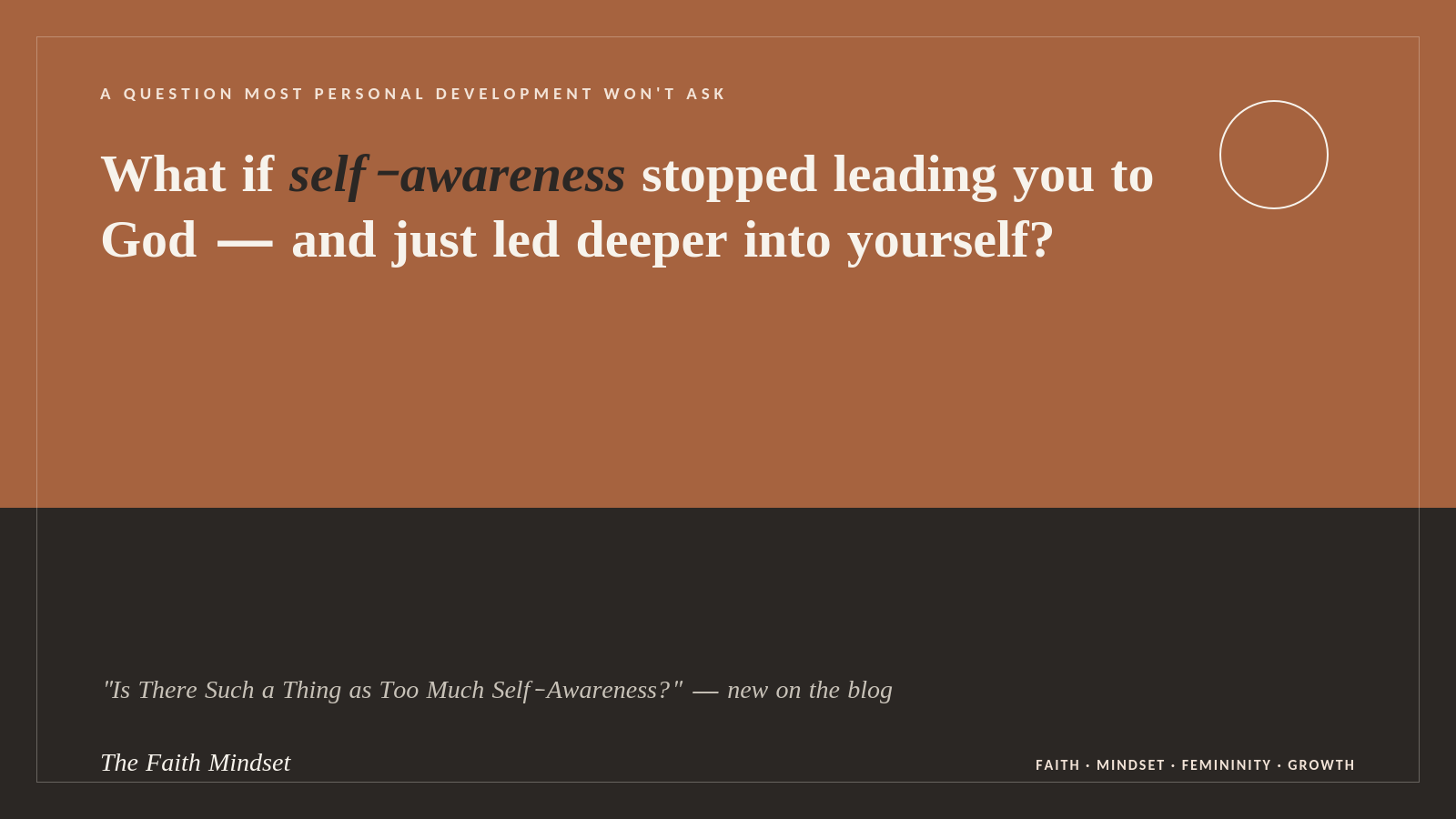

  • Self-Awareness Is Secretly Sabotaging Your Growth

    Self-Awareness Is Secretly Sabotaging Your Growth

    Self-awareness has become personal development’s golden rule — the assumption that more of it is always better, that if a little insight helps, unlimited insight must help even more. Here’s a question worth asking honestly: what happens when self-awareness stops leading you toward God and starts leading you only deeper into yourself?

    This isn’t an argument against self-awareness. It’s an argument against treating it as the destination instead of a doorway.

    What Healthy Self-Awareness Actually Does

    At its best, self-awareness helps you notice patterns, recognize triggers, and understand your own responses well enough to grow. It’s the mechanism behind nearly every meaningful change we’ve talked about on this blog; noticing the identity you’re operating from, recognising a limiting belief, seeing a relational pattern clearly enough to interrupt it. Self-awareness, used well, is a tool for transformation.

    The key phrase there is used well — because self-awareness was always meant to be a means, not an end.

    Where Self-Awareness Secretly Starts Sabotaging Your Growth

    Over-analysis paralysis. At some point, reflection stops producing clarity and starts producing more reflection. You can journal about a decision so many times that you never actually make it — insight becomes a substitute for obedience instead of a path toward it.

    Self-focus mistaken for growth. There’s a subtle but important difference between examining yourself to become more like God, and examining yourself simply to understand yourself better. The first has a destination. The second can spiral inward indefinitely, mistaking constant self-focus for spiritual depth.

    Using awareness to excuse instead of change. “I know I do this because of my childhood” can be a genuine insight, or it can become a permanent explanation that quietly excuses you from ever actually changing the pattern. Awareness without action just becomes a very articulate way of staying the same.

    Anxiety dressed up as insight. Hyper-awareness of your every flaw, motive, and reaction can tip into a kind of self-surveillance that looks like growth but functions like anxiety — constantly monitoring yourself instead of resting in who God says you are.

    The Biblical Corrective: Renewal, Not Just Awareness

    This is genuinely worth noticing: scripture rarely stops at self-examination for its own sake. 2 Corinthians 13:5 does say to examine yourselves, but the purpose stated is to test whether you’re in the faith, not to spiral into endless self-analysis. The examination has a destination.

    Romans 12:2 again offers the corrective: renewal, not just awareness. Awareness that never leads to transformation isn’t actually doing what self-awareness was meant to do. Psalm 139:23-24 is instructive here too, David invites God to search him and know his heart, and to lead him in the way everlasting. The self-examination isn’t the end of that prayer. It’s the beginning of being led somewhere.

    Signs Self-Awareness Has Tipped Into Self-Focus

    • Endless reflection with no resulting action or change.
    • Using insight about yourself as a permanent excuse rather than a starting point.
    • Feeling more anxious and self-conscious the more “aware” you become.
    • Analysing your motives so much you forget to simply obey what you already know to do.
    • Turning inward so consistently that God becomes an afterthought in your own self-examination.

    How To Practice Self-Awareness Without Sabotaging Your Growth

    • Give every reflection a destination. Ask not just “what do I notice about myself?” but “what is God asking me to do with this?”
    • Set a limit on analysis. If you’ve journaled the same insight five times without a resulting action, the next step isn’t more insight, it’s obedience.
    • Let awareness lead you toward God, not just toward yourself. The goal was never to become an expert on yourself. It was to become more like Him.
    • Notice if awareness is producing anxiety instead of peace. Healthy self-awareness tends to lead toward clarity and rest. If it’s producing constant unease, something has shifted from insight into self-surveillance.

    Self-Awareness Was Always Meant to Be a Doorway

    There’s nothing wrong with knowing yourself well, scripture actually invites it. But self-awareness was never meant to be the final destination of your growth. It’s meant to be the doorway that leads you toward transformation, toward God, toward actually becoming who you’re being built to be. When it stops leading anywhere and just becomes a room you stay in indefinitely, it’s worth asking whether the mirror has quietly replaced the window.

    If this made you reconsider something today, I’d love to hear from you. Comment below with one area where insight might be waiting for action. And if this is your first time here, subscribe below to get reflections like this delivered straight to your inbox.

    Welcome to The Faith Mindset — a safe space to learn, grow, and thrive.
    I’m so glad you’re here.

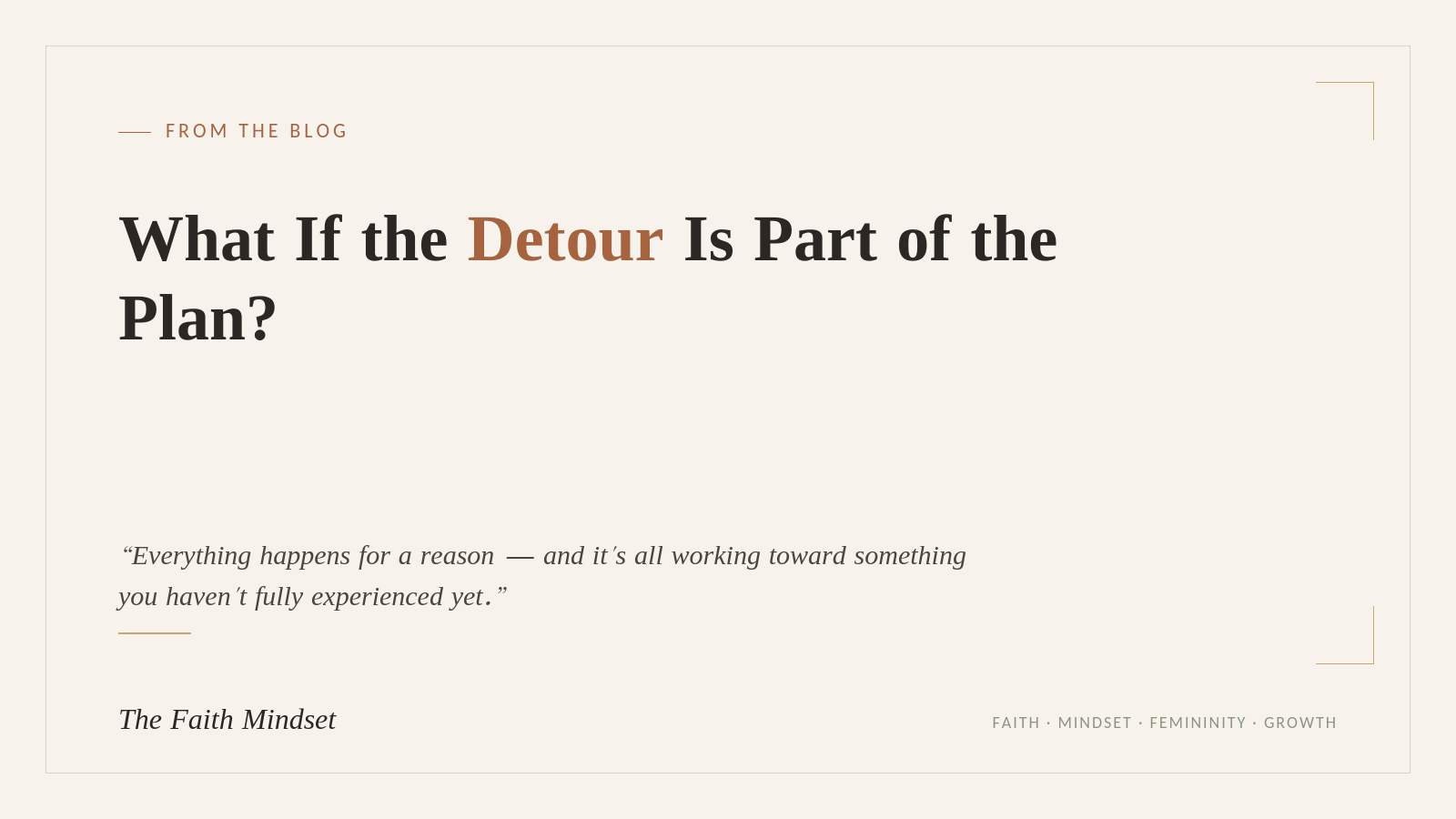
  • What If the Detour Is Part of the Plan?

    What If the Detour Is Part of the Plan?

    You had a picture in your mind of what your life was supposed to look like. The job, the relationship, the timeline, the version of “accomplished” you were working toward. And then life took a turn you didn’t choose — and now you’re standing somewhere you didn’t plan to be, wondering if you got off track, or worse, if you missed the plan entirely.

    Here’s a reframe worth sitting with: what if the detour was never a departure from the plan? What if it was the plan, just not in the shape you expected?

    Why Detour Feels Like Failure

    Society has handed us an invisible timeline — by when you should be settled, established, married, promoted, “figured out.” So when life doesn’t follow that script, it doesn’t just feel inconvenient. It feels like proof something went wrong, like you’re behind in a race everyone else seems to be running on schedule.

    But timelines are man-made. And not every detour is a derailment, some of them are the very road that gets you somewhere the straight path never could have.

    Life Happens For You, Not To You

    This is a mindset shift worth building your whole outlook on: everything happens for a reason, and there are no coincidences. Every season — even the painful, confusing, unplanned ones — is working toward something you haven’t fully experienced yet.

    There’s a real difference between believing life happens to you and believing it happens for you. If you operate from “life happens to me,” every hardship reads as an attack, evidence that you’re unlucky, behind, or being punished. That orientation needs to be gently corrected. Not because the pain isn’t real, but because the framing keeps you stuck in why is this happening to me instead of moving forward.

    If you shift to “life happens for me,” the posture changes entirely. It doesn’t mean every hard season feels good. It means you trust that even the difficult ones are moving you somewhere, working something in you that the easy seasons couldn’t.

    From “Why Is This Happening?” to “What Is This Teaching Me?”

    Here’s the practical shift: instead of staying stuck on why did this happen to me, ask instead — what is this teaching me right now? What’s my takeaway from this season?

    This single shift in question does something powerful, it helps you release excess emotional weight instead of carrying it indefinitely. And to be clear, this doesn’t mean skipping the grief, the sadness, the anger. Feel all of it. Throw the tantrum if you need to. Let the emotion move through you fully. But at the end of it, come back to the lesson. Let the feeling pass through rather than set up permanent residence in you.

    There’s a popular saying worth holding onto here: life will keep giving you the same lesson, in different forms, until you finally learn it. Whether it shows up as the same pattern in relationships, the same financial cycle, the same kind of disappointment wearing a different dress — until the lesson is learned, the season tends to repeat itself in different forms. Learning and applying the lesson is often what finally allows you to move forward.

    A Biblical Anchor: Joseph’s Detour

    Sold into slavery by his own brothers, falsely accused, forgotten in prison for years — by any measure, his life looked like one long detour away from anything resembling a plan. And yet, years later, reunited with the very brothers who betrayed him, he says something remarkable: “You intended to harm me, but God intended it for good” (Genesis 50:20).

    Notice what he doesn’t say. He doesn’t say the harm wasn’t real, or that the years weren’t painful. He says both things were true — the betrayal happened, and God was working through it the entire time. The detour wasn’t a delay from the plan. It was the path that built exactly who Joseph needed to become to fulfil the plan.

    Signs You Are Treating A Detour Like A Dead End

    • Comparing your timeline to people who didn’t experience your detour.
    • Holding resentment toward the “wasted” time instead of staying open to what it built in you.
    • Refusing to extract any lesson from the season because you’re too focused on resenting that it happened.
    • Believing the detour disqualifies you from the original purpose, instead of preparing you for it.

    A Practical Exercise: The Detour Reflection

    Take a few quiet minutes today.

    1. Think of a season you’d call a detour — something unplanned, painful, or off-script.
    2. Ask honestly: what skill, strength, or perspective came because of this season — not despite it?
    3. Write one sentence completing this: “This season taught me ____, and I wouldn’t have learned it any other way.”
    4. Thank God for the lesson, even if you’d never choose to repeat the season itself.

    Want to go deeper? Download The Detour Reflection Journal. It’s a free guided PDF companion to this post. Drop your email below and it will land straight in your inbox.

    The Detour Might Be the Stepping Stone

    The season you’re in right now — the one that doesn’t match the picture you had — might not be a delay from your purpose. It might be the very thing building you toward a version of it you didn’t even know you needed. Trust the process, stay teachable in the waiting, and watch what the detour was actually preparing you for all along.

    If this met you in a season that feels off-track, I’d love to hear from you — comment below with one lesson a hard season taught you that you wouldn’t trade. And if this is your first time here, subscribe to get reflections like this delivered straight to your inbox.

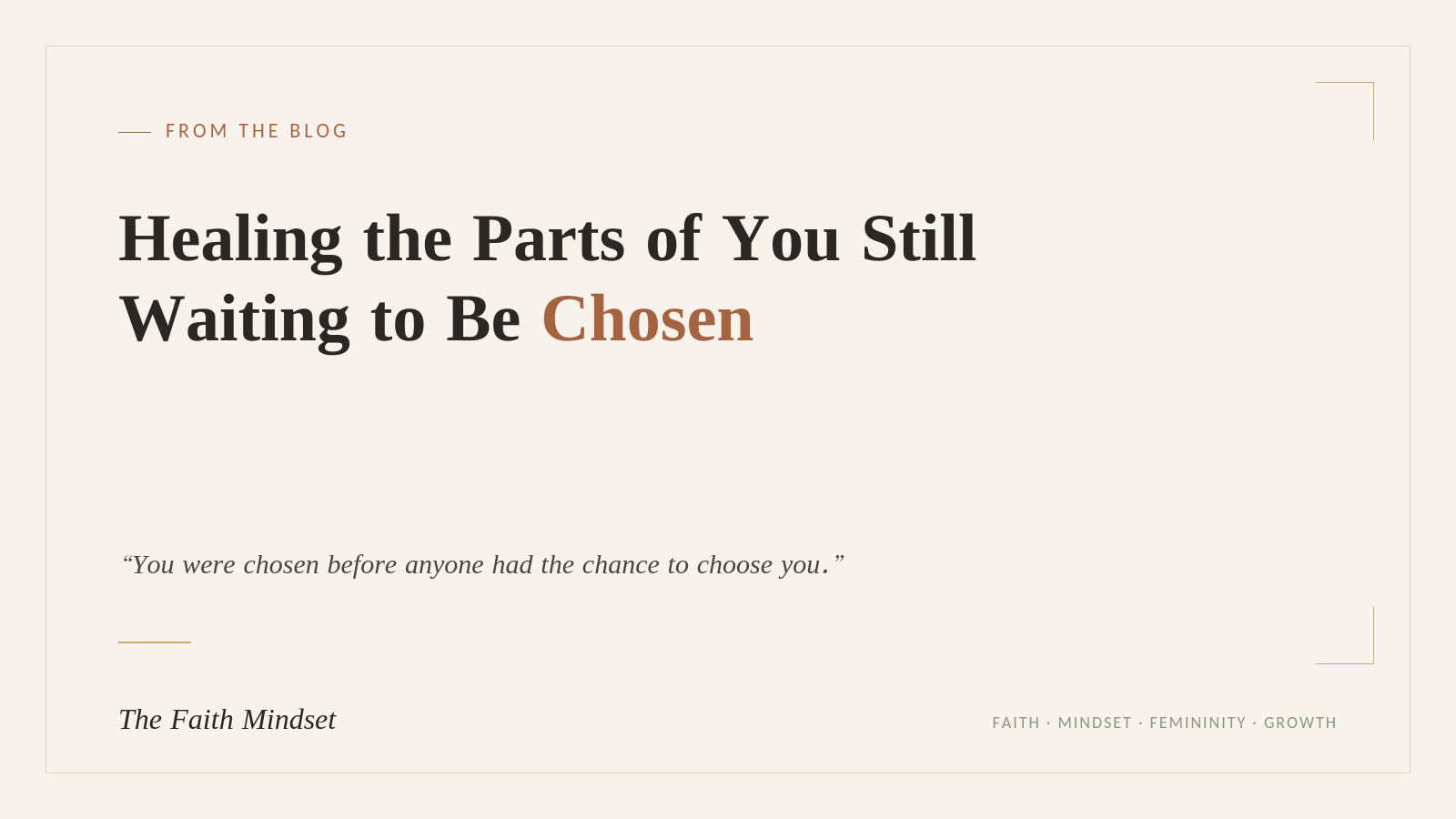
  • The Painful Truth Behind Waiting to Be Chosen And How to Heal

    The Painful Truth Behind Waiting to Be Chosen And How to Heal

    Some parts of us are still standing by the door, waiting to be picked. Waiting for the call, the text back, the invitation, the “yes.” Waiting to finally feel chosen — by someone, anyone — so we can stop wondering if we’re worth choosing at all.

    If you’ve ever felt that quiet ache, this post is for you. Not to shame the waiting, but to gently walk you toward the truth that can finally end it.

    Still Waiting to Be Chosen? Here’s What’s Really Going On

    Why We Wait to Be Chosen In The First Place

    This isn’t only about romance, though it often shows up there first and loudest.
    It’s about identity and it shows up everywhere you’re still asking someone or something outside of you to confirm your worth before you’ll fully receive it, act on it, or believe it. So we perform. We shrink. We overextend ourselves to be liked, needed and eventually, be picked.

    The ache doesn’t come from being unloved, it comes from looking for love and our self-worth in places that were never meant to define us.
    It can sound like:

    • Waiting for a parent to finally say “I’m proud of you” before you feel allowed to be proud of yourself.
    • Waiting for your spouse to notice the way you show up before you believe you’re enough. Meanwhile, over-loving or over-giving in the meantime, hoping you’ll finally be seen and loved the way you crave to be loved.
    • Waiting for a boss, a client, or a room full of people to validate your idea before you let yourself believe it’s worth pursuing.
    • Waiting until you “have enough” — enough money, enough capital, enough equipment, enough certainty — before you finally take that bold step you’ve been carrying for years.

    That last one deserves its own sentence: waiting to be “ready” is often just waiting to be chosen, wearing a more acceptable disguise. It feels responsible. It feels wise. But underneath it can be the same old ache — I need something outside myself to confirm this is safe, valid, worth doing — before you’ll take any action.

    Somewhere along the way, many of us absorbed a quiet belief: I have to earn my place. I have to be chosen — by a person, by perfect conditions, by certainty itself — to know I’m allowed to take up space.

    Signs You Are Still Waiting to Be Chosen

    This waiting can be sneaky. It doesn’t always look like loneliness — sometimes it looks like:

    • Over explaining yourself to be understood or for your opinion to be accepted.
    • Saying yes when your spirit is whispering no.
    • Feeling unsettled when you’re not anyone’s first choice.
    • Replaying conversations, wondering if you said too much or too little.
    • Struggling to feel “enough”, [pretty enough… smart enough…loveable…], unless someone else confirms it.
    • Delaying the business, the trip, the bold next step — waiting for the right time — when what you’re actually waiting for is permission.
    • Over-functioning in a relationship — at home, at work, in friendships — hoping enough giving will finally make someone see your worth.

    If you recognised yourself in even one of these, take a breath. This isn’t a flaw to fix overnight, it’s a wound asking to be healed, gently. And it doesn’t only live in matters of the heart. It can live in your home, your career, your business plans, the goal you haven’t taken action on because you’re still waiting for someone to tell you it’s good enough to pursue.

    The Truth That Changes The Waiting

    This is where your mindset shifts: you were chosen before anyone had the chance to choose you.

    Ephesians 1:4 reminds us that we were chosen before the foundation of the world — not after we proved ourselves, not after we became impressive enough, not after someone finally noticed us. Before any of that. You didn’t get picked late. You were never not picked.

    This truth doesn’t erase the pain of past rejection. But it does loosen its grip. The validation you’ve been waiting for from people was never going to satisfy the ache anyway, because the ache was never about people. It was about identity.

    How To Begin Healing This Part Of You

    Healing isn’t instant, but it is possible and it starts with small, intentional shifts:

    • Name the wound, don’t numb it. Whether it was a parent, a friendship, a relationship — naming where the belief started helps you separate the old story from the truth.
    • Practice receiving, not performing. Notice the moments you’re tempted to overextend yourself for approval. Pause. Ask: would I still offer this if no one was watching?
    • Speak the truth until it’s louder than the lie. Try saying aloud: “I am already chosen. I don’t have to earn what’s already mine.”
    • Let God’s choosing be the final word. Bring the ache to Him directly, even if it feels small or silly. He’s not waiting for a polished prayer.

    A Practical Exercise: The Chosen Reflection

    Set aside at least 5 minutes today:

    1. Write down one relationship or situation where you felt “not chosen.”
    2. Next to it, write the belief that moment created (example, “I was rejected because I’m not pretty enough”).
    3. Cross it out, and write Ephesians 1:4 beside it instead.
    4. Read it aloud. Let it sit with you. You don’t have to feel different immediately, you are just starting to tell yourself a truer story.

    You Don’t Have to Wait Anymore

    The part of you still standing by the door — she can finally rest. Not because everyone will choose her now, but because she was never waiting on the right people to begin with. She was waiting to come home to the truth: she was chosen all along.

    If this met you somewhere today, I’d love to hear from you — comment below with one truth you’re choosing to believe over the old waiting story. And if this is your first time here, [Subscribe by clicking on the link below], to get posts like this delivered straight to your inbox, so truth reaches you before the noise does.

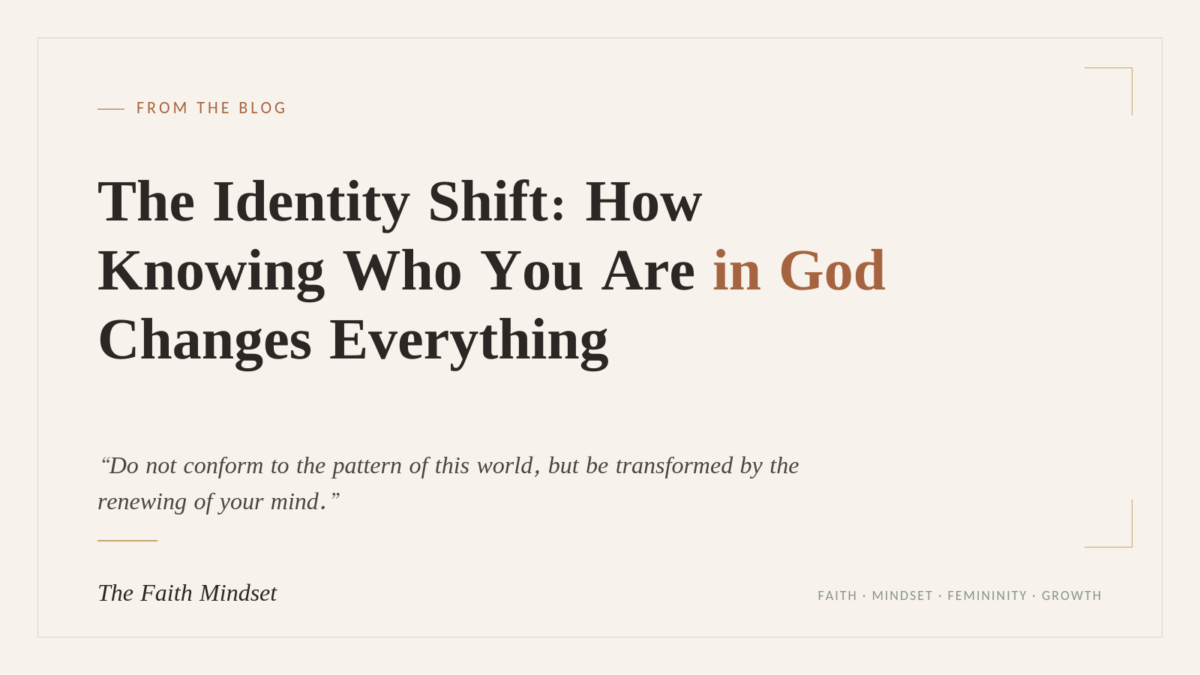
  • The Identity Shift: The Truth About Who You Are And How It Changes Everything

    The Identity Shift: The Truth About Who You Are And How It Changes Everything

    You can change your habits, your routine, your morning affirmations, and still feel stuck. That’s because most of us are trying to fix our behaviour before we’ve settled the deeper question: Who do I actually believe I am?

    This is the identity shift. It’s the difference between temporary motivation and long lasting transformation.

    Why Mindset Work Alone Isn’t Enough

    Mindset shifts and affirmations are very powerful tools, but they work best when they are built on solid ground. If you’re affirming, “I am worthy” or “I am enough”, while secretly believing, deep down, that your self worth depends on performance, external approval, or your results, the affirmation becomes a Band-Aid instead of a firm foundation.

    Real changes starts when you stop asking “how do I become more confident?” and start asking “who has God said I am?”

    That single question shifts your focus from chasing external answers to seeking internal truths and that’s where everything begins to change — your confidence, your boundaries, your relationships, your purpose.

    What Identity in God Actually Means

    This isn’t about ignoring your struggles or pretending you have it all figured out. It’s about anchoring your sense of self somewhere steadier than your circumstances, your past, or other people’s opinions.

    A few truths worth sitting with:

    • You are not defined by your worst season or your most recent mistake.
    • Your worth was never meant to be earned through striving for something outside yourself.
    • God’s view of you isn’t shaped by your results, your relationship status, or your follower count. He loves you just because…
    • The version of you that feels “not enough” is often operating from an old, false identity, not the true one.

      Romans 12:2 puts it simply: “Do not conform to the pattern of this world, but be transformed by the renewing of your mind, so that you may discern what is the will of God.” Renewal isn’t a one-time event. It’s a daily choice to think differently about who you are.

    Signs You’re Operating from a False Identity

    Sometimes, we don’t even realise we’re living from the wrong script. A few common signs:

    • Constantly comparing your life, timeline, or progress to other people.
    • Feeling like you have to prove your worth through achievements.
    • Struggling to rest without feeling guilty.
    • Basing your self-image on how others perceive you.
    • Feeling lost or anxious when your plans don’t go the way you expected.

    If any of these feel familiar, it’s not a character flaw, it’s a sign the identity shift hasn’t happened yet. But hey! There’s good news; it’s never too late. Your identity can still shift.

    How to Begin the Identity Shift

    This isn’t an overnight fix, but it is a daily practice.
    Some place to start:

    • Get quiet enough to hear the truth. Limiting beliefs are loud and the truth is usually quieter. Make conscious effort to quieten your mind, sit in silence/meditate, journal, and most importantly, pray.
    • Replace each lie with its specific truth. Generalised affirmations don’t work. To see results, affirmations has to be specific to you and the limiting belief you are working to overcome. Don’t just say “I am enough.” Say what you are replacing. For instance, “I don’t need to perform to be loved.” This affirmation replaces that voice in your head that has convinced you that you have to do more and more to be loved or accepted by others.
      Someone who loves you simply does. Just like Jesus loves us. We’ve done nothing to merit this love. He just loves us.
    • Let go of the comparison loop. Someone else’s becoming is not a measure of your falling behind.
    • Return to the Word as your mirror. Scripture isn’t just inspiration, it’s meant to reflect back who you actually are underneath who the world told you to be.

    You Were Never Meant to Build Yourself From Scratch

    Here’s the freedom in all of this: you don’t have to manufacture a new identity through sheer willpower. You’re not starting from zero. You’re returning to something that was already true before the noise , the comparison, and the striving got loud.

    The world will keep handing you a script and people will still tell you to do/be more. The identity shift is choosing, daily, to put the worldly script down and pick up the truth that has been there all along.

    So Where Do You Go From Here?

    You don’t need to have this all figured out today. The identity shift isn’t a switch you flip, it’s a posture you keep retuning to, especially on the days the old, false identity feels louder than the truth.

    So here’s where I’d encourage you to start: pick one lie/ limiting belief you have about yourself —just one— and bring it to God today. Not to fix it instantly, but to replace the lie with a truth you start telling yourself frequently. That’s how renewal happens. Quietly, daily, intentionally.

    You aren’t behind. You are not far gone. You are not what your worst season said about you.
    You are who God says you are and that’s the identity worth building your whole life on.

    If this spoke to you, I’d love to hear from you. Drop a comment below and tell me one truth you are choosing to believe today instead of the old narrative. And if you know a woman who needs the reminder, share this post with her.

    Want reflections like this delivered to you? Subscribe below to get new posts from The Faith Mindset sent straight to your inbox, so the truth reaches you before the noise does.

    And if you are someone who needs visuals to carry the message with you, come find me on Pinterest (click the link below). That’s where I’m sharing daily affirmations, scripture, and mindset prompts that pair with everything you read here.

    https://pin.it/5m3sOifxo